|
Here is a summary of all that is known about C.J:
| |||||||||||||||||||||||||||||||||||
| Common names: |
 Crevette mangeuse d'algues, Crevette du Japon/d'Amano/de Yamato Crevette mangeuse d'algues, Crevette du Japon/d'Amano/de Yamato
Zoological classification:
|
Phylum : Invertebrates, Arthropoda, Crustacea | Class : Malacostracea, Eumalacostracea Order : Eucarida, Décapoda ; Sub-order : Pleocyemata, Caridea Family : Atyidae ; Genus : Caridina Species : Caridina Japonica
Natural Habitat:
| Japan (Yamato swamps), Taiwan, Korea.
|
Life span:
| from 2 to 3 years.
|
Morphology:
| General shape and features identical to other caridina species, adult size from 3 to 5 cm.
Transparent greyish body (but color may change slightly according to food and lighting) with regularly spaced black dots forming lines on the sides. The grey color becomes denser on the back, and a white line runs along the spine from the head to the tail.
|
Moulting:
|
Like all crustaceans, Caridina japonica moults according to its growth: the faster it grows, more often it will need to moult. Thus a month-old juvenile will moult more often than a grown adult, but then adults still need to moult in order to renew their shell, as well as their limbs lost in fights or due to predators. It is difficult to be precise here, because I gather it varies a lot according to food and water, but in my own experience I'd expect a very young juvenile to moult once a week, a 6-month-old young shrimp about a couple times a month, and a year-old adult about 5 to 10 times a year. This frequency should decrease steadily until the death of the shrimp : a very old shrimp at the end of its life may not moult more often than 2 or 3 times a year. Those figures are only rough estimates I extrapolated from the growth rate of my own shrimps, and from the few empty shells I find in my tanks.
|
Behaviour:
|
In their natural habitat, Caridina Japonica are gregarious animals that live in shoals of several hundreds. But this gregarious instinct is barely obvious in our tanks, since we often keep them in scarce numbers, and also due to the lack of space in most freshwater tanks. | These shrimps have no problem living with other fishes or shrimps (beware of aggresive shrimps such as macrobrachia, though), insofar as the fishes do not get too interested in them. If so, the shrimps will readily swim around in your tank and you will often see them. But if the fishes do get interested in them, in a "gastronomic" sort of way (if you see what I mean ;-), you will barely be able to see them; at best because they're hiding all the time, at worst because they've been eaten. Most of the time they are peaceful creatures, all-day-long scouring the bottom of the tank in their never-ending search for food. But once in a while you will find them racing around like crazy. There can be a few reasons to that frantic beahaviour: - If only the males are racing around trying to copulate with everything in sight, you can be sure a female is ready to mate and has released her pheromones in the water. - If both males and females are running Indycar-like, they are either welcoming a recent fresh-water change, or else sadder news: somewhere in your tank a dead fish is arousing their appetite for carrion flesh... Besides it is not unusual to see them attack some fish dying at the bottom even though it is still alive.
How many of them in a tank ?
|
Since they are gregarious animals, I should say as many as you can afford... Until now, given the the price of the little beasts, and the difficulties in breeding them, there really was no risk of having your tank overpopulated with them. But now, with my method of breeding, I have started to think more seriously about the maximum number of them I wish to keep in my tank, just so that it doesn't get too crowded. So here is my own way of calculating : just measure up the surface of the bottom of your tank (length x width) and plan for 1 to 2 meters of shrimp per square meter. For example my 200L tank has a 40 x 100 cm base, which makes 0.4m². That means I can afford to put 40 to 80 cm of shrimps, which means from 10 to 20 individuals (average size 4cm). This is just my opinion about what I consider a reasonable average population, but you'll also have to consider other parameters, such as other bottom-dwelling fishes (who don't like to share their "territory") which will reduce your overall available surface.
|
Sexual dimorphism :
|
|  There are a few differences between males and females, the first and most obvious being the size: males are fairly smaller (about 3cm) than the females (5cm). Indeed, the females are bulkier, for they have a bigger abdomen, which is meant to carry the hundreds of eggs that are hatched each month. Of course, when a female carry its eggs, this difference becomes obvious since the mass of eggs can be distinctly and unmistakably noticed under its belly. Last difference, the pattern formed by the black spots on the sides : on males, the spots are distinct and rather evenly spaced, while on females, in some places they tend to stretch out and merge with one another, forming rough broken lines.
Breeding :
|
Females have a 6-week-long cycle; when one is ready for fecundation, she releases pheromones in the water, and their effects on the males is quite visible : they become frantic, literally trying to copulate with everything in sight until they find the female. Then they will all mass around her - or rather, upon her – for mating. But only one “lucky” male will be allowed to mate with the female, for a few seconds. Thus the female will be able to carry its eggs for about 5 weeks, before hatching hundreds of live larvae. | The larvae are hatched in the fresh water of streams and rivers. But they are plankton-like, and for all practical purposes unable to swim, so they are washed-out downstream to the brackish waters of the river’s mouth.There they will grow for about 6 weeks, until their metamorphosis; then, they will swim back upstream to their natural habitat. Here lies the prime difficulty in breeding them, for you have to duplicate those water conditions, which means adding salt and then removing it in accordance to the growth of the larvae. And that means that you will not be able to breed them in the main tank where the adults are kept; so a separate tank will be necessary.
Feeding :
|
Amano shrimps are renowned for their appetite for algae, which is the main reason why so many aquarist keep them. But their diet includes much more than just algae; like most other crustaceans, they are fond of almost every kind of organic waste that they can find on the bottom of your tanks. But strangely enough, for alleged vegetarians, they don't seem very fond of dead plants. | On the other hand, they are great fans of carrion flesh: dead fishes put them in a frantic state (indycar-racing around the tank) and a carcass never stay intact for long if some shrimps are taking care of it...  And that is the main benefit of having shrimps in your tank : they eat a lot of organic waste and thus help preventing water pollution. But since that's not their only purpose, do feed them from time to time with special food for crustaceans or other food in pellets. Mine are particularly fond of JBL novo fect pellets.
Water quality :
|
Caridina Japonica may adapt to almost any kind of freshwater, with a moderately basic or acid pH, and a very wide range of GH/KH values. As for temperature, you can keep them in any water between 23 and 27°C. The sole limitation I can see is for the Amazonian specific tanks with very soft water (0 GH/KH) : as all crustaceans need calcium and other essential minerals in order to renew their exoskeleton, so avoid keeping them in pure, osmosed water. | Watch out for the presence of heavy metal traces (eg. lead) in your water, since those pollutants are very harmful to crustaceans.
| | |||||||||||
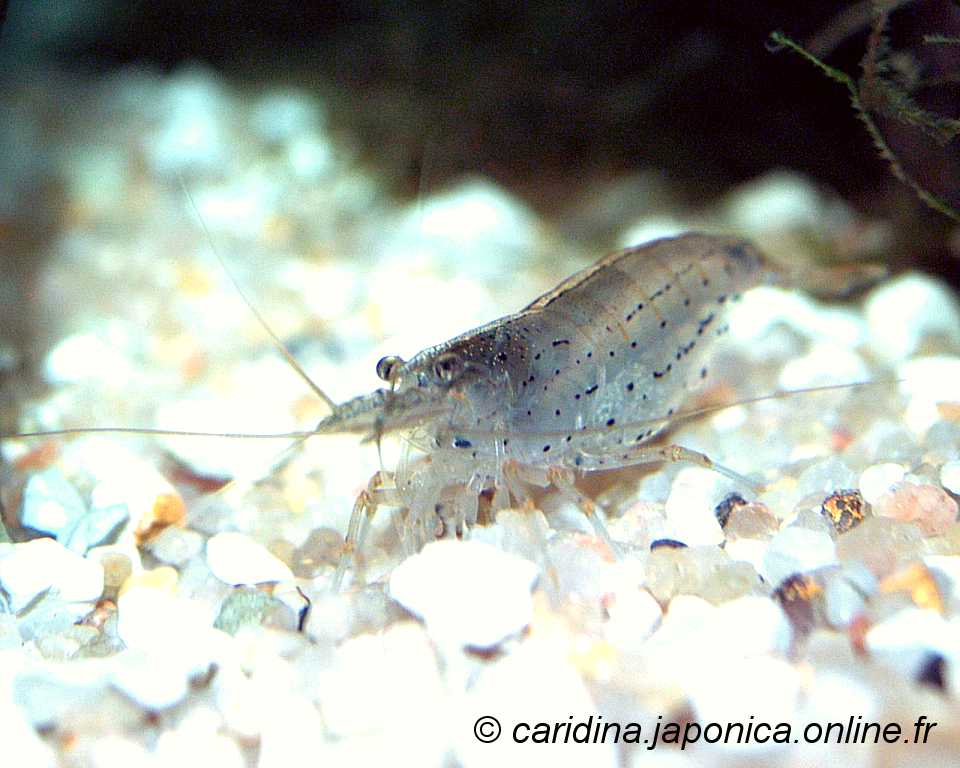

 Amano/Yamato/Algae shrimp, Japanese Swamp shrimp
 Amano-Garnele
 Gambero di Yamato
 Yamato Numa Ebi ("Yamato swamps shrimp")
© Patounet 2005